
Roast to Order Coffee: Why Freshly Roasted Beans Taste Better
Your coffee was roasted months before it reached your mug. Those weeks on a warehouse shelf and a grocery aisle cost you the aroma that makes a fresh bag worth opening, and the flavor fades with every one of them.
By the end of this article, you will understand what roast-to-order means at Kochere Coffee and why degassing and oxidation turn a once-vibrant bean stale. You will also know how single-origin lots are scored, what the Coffee of the Month subscription includes, and whether freshly roasted beans are worth the switch.
What Is Kochere Coffee? Roast-to-Order Specialty Coffee Explained
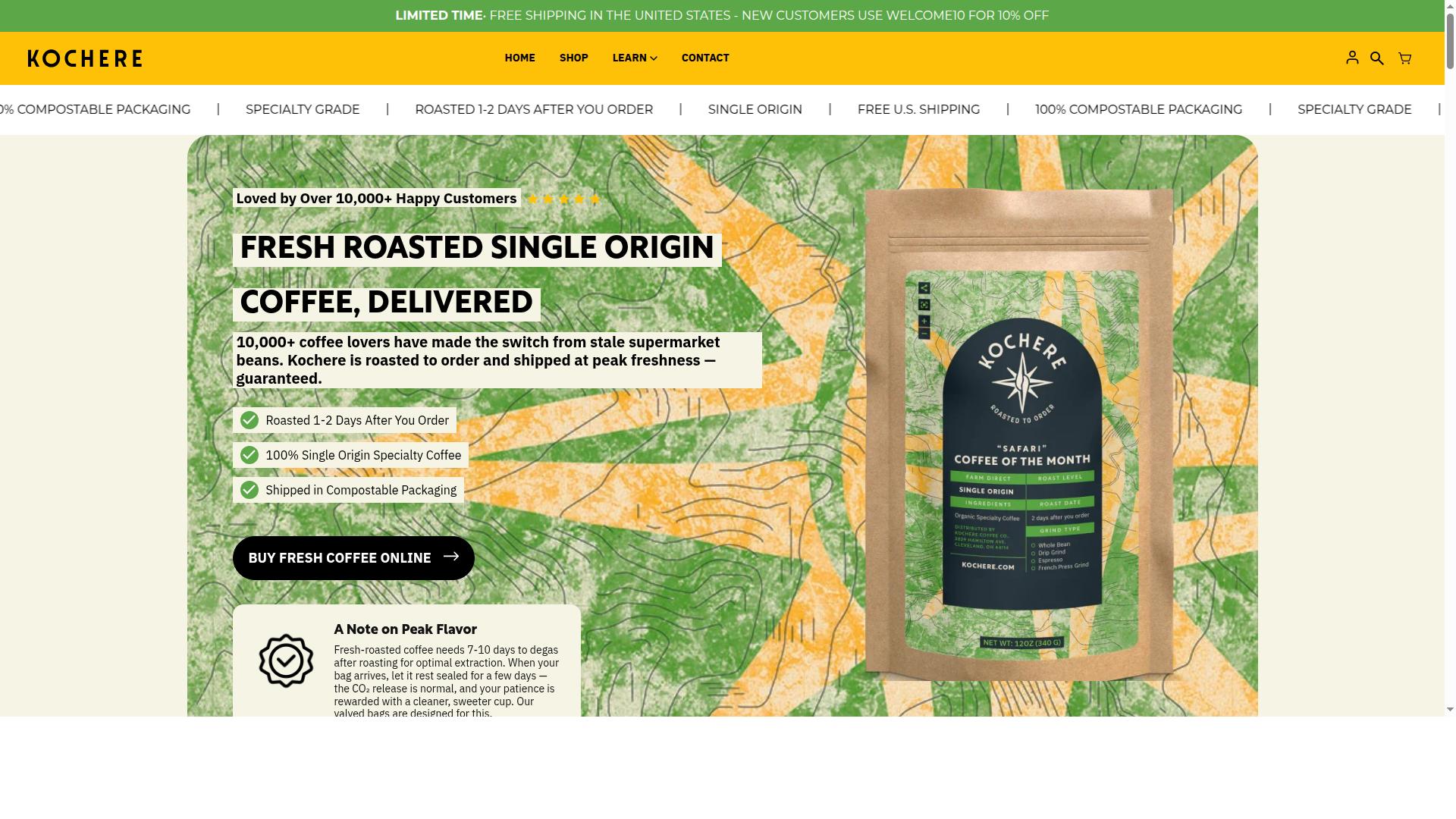
Kochere Coffee is a roast-to-order specialty coffee roaster that roasts every bag only after you order it, then ships it the same day it's roasted. That is the whole idea in one line: nothing sits on a shelf. Your beans are still warm from the roaster when they begin their journey to your door.
The name is pronounced "Koh-Chuh-Ray." It honors the Kochere district in Ethiopia's Gedeo zone, one of the world's celebrated coffee-growing areas. Every bag is roasted in a small batch only after it is ordered, which means your coffee is never pulled from stock that has been waiting weeks for a buyer.
So what does specialty coffee actually mean? In plain terms, it is coffee that has been cupped and scored 80 or higher on the Specialty Coffee Association scale. Kochere goes a step further: every lot is cupped and scored by certified Q Graders, and the coffee comes farm direct from smallholder cooperatives across eight growing regions in Africa and the Americas.
You can buy direct from Kochere online or through Amazon, and it ships nationwide in the US with free shipping in the continental US. You pick your coffee, your bag size, and your grind, whether whole bean, drip, coarse or fine. It all arrives in 100% compostable packaging.
- Roasted after you order: your coffee is roasted only once your order is placed, never before.
- Ships the same day it's roasted: the roast date on your bag is close to the day it lands on your counter.
- Single-origin focus: specialty-grade Arabica from named regions, sourced farm direct with no middlemen.
Those three traits work together. On-demand roasting keeps coffee freshness intact, a same-day ship keeps the gap short, and a single-origin focus means you taste one place in your cup, not a blend hiding behind it. That is the difference between coffee that tastes alive and coffee that tastes like it has been waiting.
Why Does Roast-to-Order Coffee Taste Better? The Freshness Answer
Freshness isn't a marketing word in coffee - it's a measurable window between roast day and your first sip, and roast-to-order coffee is built to land inside it. Think of that window as a timeline with three stops: roast day, a short rest while the beans settle, and the peak flavor window when everything opens up.
Coffee is a perishable agricultural product, not a shelf-stable commodity. The roast date on the bag is the single most useful piece of information you have as a drinker, because it tells you exactly where on that timeline your beans are sitting.
The two sections below break down what happens inside the bean during that window, and how an order placed today becomes a bag roasted and shipped the same day.
Degassing, Oxidation and the Stale Bean Problem
Right after roasting, beans release carbon dioxide in a process called degassing, and that rush of gas is actually a good sign - it's the bean settling into its peak flavor window. This carbon dioxide release plays out over roughly the first 4 to 14 days after roast, depending on the bean and the roast level.
Too much gas too soon can work against your brew. A very fresh bean can taste flat or foam up oddly, which is why a short rest helps. Once the gas settles, the sweetness and aromatics you paid for start showing up in the cup.
Then comes oxidation. Once the bean meets oxygen, its oils and aromatics slowly fade. That's the quiet reason a bag roasted months ago tastes dull and papery, no matter how carefully it was stored or how tight the seal.
Here's the practical part:
- Look for a roast date, not a best-by date. A best-by tells you nothing about coffee freshness.
- Aim to brew within about 2 to 4 weeks of roast for most coffees.
- Store beans whole, sealed, and away from light and heat to slow oxidation.
The roast date turns guesswork into a decision you can actually make at the bag.
What "Roasted Only After You Order" Means in Practice
In practice, "roasted only after you order" means your bag doesn't exist as a finished product until you click buy - the roaster pulls green coffee, roasts a small batch, and ships it the same day. Here's the sequence, step by step:
- You place your order.
- Green coffee beans are selected for that coffee and batch.
- A small batch goes through small-batch roasting on demand.
- The beans rest just long enough to settle before shipping.
- Your bag ships the same day it is roasted.
At Kochere Coffee, every bag is roasted only after you order it, never pulled from warehouse stock, and it ships the same day it is roasted. The site notes roasting happens 1 to 2 days after you order, so your freshly roasted beans arrive near the start of their peak flavor window.
Contrast that with the warehouse model, where coffee roasted weeks or months ago waits in a fulfillment center. Nothing wrong with the people running it, but the calendar inside the bag is already against you.
Expect a roast date within days of arrival. If the bag lands very fresh, give the beans a short rest before brewing, then enjoy them across the following weeks. That's coffee freshness you can read on the label and taste in the cup.
Key Features That Make Kochere Coffee Stand Out
Kochere's lineup is built around single-origin lots, scored by certified Q Graders and packed in 100% compostable bags, three choices that shape how the coffee tastes and how it reaches you.
Each decision follows the same idea: keep the coffee tied to a place and a person can trace it. Sourcing and scoring decide what goes into the bag. Packaging decides what happens after.
The sections below walk through all three, from the cupping table to the moment you open the bag.
Single-Origin Lots, Q Grader Scoring and 100% Compostable Packaging
Every Kochere lot is a single origin, one region, one flavor story, and each one is cupped and scored by certified Q Graders before it joins the lineup.
That matters because a single-origin coffee lets you trace flavor back to a place and a process. The Ethiopian Harrar is a natural process, medium roast from heirloom cultivars in the Oromia region, with berry, honey, chocolate and wild fruit in the cup. The Ethiopian Sidamo is also natural process, a medium-light roast from Sidama Zone heirloom cultivars with milk chocolate, caramel and fruit.
Other origins round out the list. Tanzanian Peaberry from Mbeya is washed and medium-light, with pear, jasmine and strawberry. Kenyan Nyeri & Embu is washed, AB grade, bright and fruity. Brazilian Santos brings chocolate, roasted almond and cocoa, while Colombian Medellín offers dried orange, berry and chocolate.
Two lots are certified organic: Honduran Marcala, a medium-dark roast with caramel and brown sugar from a 1,500-member cooperative, and Ugandan Sipi Falls, washed and medium roast, grown at 1,500 to 2,500 m on Mount Elgon. Only those named lots carry the organic claim.
Scoring happens before anything ships. Lots that reach 80 or above on the SCA protocol are considered specialty grade, a mark that places them in roughly the top 3% of the world's coffee. That number is a filter, not a marketing line.
Packaging closes the loop. Every bag is 100% compostable, a practical everyday choice that keeps the focus on the coffee inside. You get whole bean or your choice of grind, in 12 oz, 1 lb, 2 lb and 5 lb sizes.
Pricing, Bag Sizes and the Coffee of the Month Subscription
Kochere sells in four bag sizes, 12 oz, 1 lb, 2 lb and 5 lb, with most single origins at $27.49 for a 12 oz bag, plus a Coffee of the Month subscription that saves up to 15% depending on delivery frequency.
Here is the full price range at a glance. Because every order is roasted on demand, you are paying for roast-to-order freshness and single-origin traceability, not a bag that sat in a warehouse for months.
| Size or Option | Price |
|---|---|
| 12 oz bag | $26.99 to $27.99 (most single origins $27.49) |
| 1 lb bag | $33.99 to $35.99 |
| 2 lb bag | $59.99 to $62.99 |
| 5 lb bag | $99.99 |
| Single Origin Sampler | $29.99 |
A few named lots show how the range works in practice. Ethiopian Harrar, Colombian Medellin, Tanzanian Mbeya AB and Ethiopian Sidamo sit at $27.49, while Brazilian Santos and Kenyan Nyeri Embu AB are $27.99. The Horn of Africa Reserve Signature Espresso Blend comes in at $26.99.
Bigger bags bring the cost per cup down, which matters if you brew daily. A 5 lb bag is a practical choice for households that go through coffee quickly, and the 2 lb size sits comfortably in between.
The Coffee of the Month subscription is the flexible route. You save up to 15%, and the discount depends on how often you choose delivery, with every 2 weeks earning the full 15%. You can skip or cancel anytime, and the Kochere team has served more than 10,000 customers.
New customers can use code WELCOME10 for 10% off a first order. Shipping is free within the United States, while Alaska, Hawaii and international orders pay shipping. Every order is also covered by the Perfect Cup Guarantee: if you are not completely satisfied, contact Kochere within 30 days for a replacement or a full refund, with no return shipping required.
Trust Signals: Q Grader Scores, Customer Reviews and Track Record
Three things back up Kochere's claims: independent Q Grader scoring on every lot, verified customer reviews on the site, and a customer base of more than 10,000 people served. None of these are slogans. They are checks you can look at before you order.
Start with the score. Every lot is cupped by certified Q Graders and must reach 80 or more on the SCA 100-point scale to be sold. That number is the entry line for specialty coffee, and it is measured by people trained to taste defects and balance, not by the roaster alone.
Kochere describes its lots as scoring in the top 3% of coffee worldwide. It is a strong claim, and the cupping table is where it gets tested, lot after lot. If a coffee does not clear the bar, it does not go in the bag.
Then there are the reviews, collected through Judge.me on kochere.com. They come from buyers who paid for their coffee, not from a marketing list. The core East African coffees each carry 168 reviews, Costa Rica and Honduras hold 118, and Colombia and Brazil sit at 70.
One Ethiopian Harrar buyer put it this way: "A wonderful complex flavor with some light hints of acidity and fruit, but is very balanced... an excellent Ethiopian coffee." That is the kind of note you hope for from a natural Harrar: fruit-forward but settled.
Other buyers echo the same theme. Stephanie, reviewing the Single Origin Sampler, wrote that she knew it would be good the moment she opened the box, with aroma so strong and delicious she gave it 10 out of 10. Christopher H. called the Brazilian Santos "amazing coffee" and said Brazilian is now his new favorite.
Amazon tells a similar story. Several Kochere coffees are rated there at 5 stars, and the Organic Single Origin Sampler holds 4.5 stars. Only the Honduran Marcala and Ugandan Sipi Falls are certified organic, so read the lot name if that matters to you.
Put the pieces together and the picture is modest but clear. A score floor set by outside graders, hundreds of reviews per core coffee, and a customer base past 10,000. For roast to order coffee, where freshness is the whole point, that record is the reassurance you want before your first sip.
Who Should Choose Kochere Coffee - and How to Brew It Fresh
Kochere fits home coffee lovers who care about freshness, origin and how their coffee is sourced - people who brew deliberately and want a roast date they can trust. If you have ever opened a bag, smelled nothing much, and wondered when it was roasted, you already understand the problem. Kochere roasts to order, so the beans in your bag are freshly roasted beans with a date you can read, not a mystery.
You will feel at home here if you brew pour over, French press, drip or espresso at home. Maybe you are deep into single-origin coffee and want to explore the world's origins one bag at a time, especially African coffees. Maybe you are just starting your single-origin journey and want guidance without being talked down to. Both are welcome.
Gift buyers looking for a thoughtful present for a coffee lover are also in the right place. A bag with a recent roast date says more than a fancy box ever could. And curious drinkers who want to taste how a Kenyan Nyeri & Embu or a Tanzanian Peaberry differs from an Ethiopian Sidamo get to follow their curiosity bag by bag.
Here is the practical part. If your bag just arrived, rest very fresh beans a few days before brewing. Bean degassing is still underway, and a short rest lets some carbon dioxide release so your cup tastes cleaner and sweeter. After that, you are in the peak flavor window, so drink up and enjoy the aromatics at their fullest.
Store your beans in an airtight container away from light and heat. Oxidation and warmth are what dull a roast, and a sealed tin in a cool cupboard does more for coffee freshness than any gadget. Grind just before brewing. The aroma when the bag opens is your first clue, and the grind is where the second wave of it hits.
Brewing method matters too. The Ethiopian Harrar's berry, honey and chocolate notes shine in a pour over, where a steady pour lifts the fruit forward. A medium roast works well in a drip machine or French press, forgiving and full on the palate. If you are choosing between methods, our post "Pour Over vs. Espresso - Which Brew Method Is Right for You?" walks through the tradeoffs.
Start with water just off the boil for lighter roasts and slightly cooler for darker ones. Keep your ratio steady so you can taste what changes when you switch origins. That is the fun of roast to order coffee: each bag is a fresh starting point. If a cup is not right within 30 days, the Perfect Cup Guarantee covers a replacement or a full refund, with no return shipping.
Final Verdict: Is Roast-to-Order Coffee Worth It?
If freshness is the thing you taste first in a cup, roast-to-order coffee is worth it, and Kochere makes the case with same-day roasting, single-origin lots and a subscription you can pause anytime.
Yes, you will pay a little more per bag than you would for coffee that has been sitting in a warehouse. What you get for that difference is a roast date measured in days, not months, and flavor you can trace back to a specific place and a specific lot.
That is the whole trade. You are not buying a label or a story. You are buying beans that were still green when you placed your order, roasted in small batches, and shipped the same day they came off the roaster.
Here is what actually tips the scale in favor of roast-to-order:
- Roasted after you order, so the bag you open has not spent weeks losing its aroma in transit or on a shelf
- Ships same day roasted, which shortens the gap between the roaster and your grinder
- Q Grader scoring, so the lots are evaluated on a consistent standard rather than a marketing claim
- 100% compostable packaging, which keeps the freshness story from ending in a landfill
- Subscription flexibility, including the ability to pause when you have more coffee than mornings
- The Perfect Cup Guarantee: if you are not happy within 30 days, you get a replacement or a full refund, with no return shipping
Single-origin lots like Ethiopian Sidamo, Tanzanian Peaberry and Kenyan Nyeri & Embu give you something to compare, too. You start to notice how a washed Ethiopian reads floral and bright while a Kenyan cup lands juicier and more structured. That kind of learning only happens when the coffee arrives fresh enough to show its character.
Roast-to-order is not for everyone, and it is fair to say so. If your only goal is the lowest possible price per bag and the roast date on the back never crosses your mind, a warehouse option will cost less. If you drink coffee slowly enough that a bag lasts several months, you may not notice the difference the way a daily brewer does.
For anyone who grinds fresh, weighs their dose, and wants the peak flavor window to start when the bag lands rather than weeks before, the math works out. You are paying for a shorter trip from roaster to cup, and that trip is the part you can taste.
Kochere Coffee is a specialty coffee roaster selling direct to you online, with single-origin lots and a subscription you control. If you want to ask about a lot, a roast level or an order, the team is reachable at support@kochere.com, and you can browse the current offerings at https://kochere.com. You will also find @kocherecoffee on Instagram, TikTok, X, Facebook and Pinterest, where the team shares what is on the roaster and what is tasting good right now.
Freshly roasted beans are a small luxury with a short shelf life and a big payoff in the cup. Whenever you are ready to try a bag, the door is open, and the coffee will be roasted after you ask for it.
Frequently Asked Questions
What does "roast to order" actually mean at Kochere Coffee?
It means nothing sits on a shelf. Every bag of Kochere Coffee is roasted in a small batch only after you place your order, then shipped the same day it's roasted so it reaches you at peak freshness.
Why does freshly roasted coffee taste better than coffee that's been sitting in a warehouse?
Coffee is at its most expressive in the days and weeks after roasting, when aromatics and flavors are still vivid; over time those qualities fade. Because Kochere Coffee roasts to order rather than pulling bags from stock, your beans arrive close to the roast date instead of months past it.
How fresh will my coffee be when it arrives?
Your coffee is roasted after you order and ships the same day it's roasted. We don't promise specific delivery dates, but because bags leave the roastery right after roasting, you're starting from a much fresher point than with warehouse-stocked coffee.
How should I store my freshly roasted Kochere Coffee?
Keep your beans whole in an airtight container, away from light, heat and moisture, and grind just before brewing for the brightest cup. Since your bag arrives freshly roasted, buying in a size you'll finish in a few weeks helps you enjoy it at its best.
Is roast-to-order coffee more expensive?
Kochere Coffee single origins start at $26.99-$27.99 for a 12 oz bag, with 1 lb, 2 lb and 5 lb options available, plus a Single Origin Sampler at $29.99. A Coffee of the Month subscription saves up to 15% depending on delivery frequency, and you can skip or cancel anytime.
What if I don't love my coffee?
Our Perfect Cup Guarantee has you covered: if you're not happy within 30 days, you'll get a replacement or a full refund, with no return shipping. Just reach out to support@kochere.com and the Kochere team will take care of it.