
Direct WordPress Publishing: SEOWriting.ai or Autoblogging.ai?
A social history of care within households: assumed for centuries, discussed publicly only recently.
You are comparing two tools that both promise to publish straight to WordPress. The difference shows up in workflow, semantic depth, and what each credit actually buys you. Choosing wrong means paying twice for the same article.
By the end, you will know how Autoblogging.ai and SEOWriting.ai handle one-click publishing, content modes, integrations, bulk capacity, and pricing. You will also get a clear verdict on which tool fits bloggers, agencies, or bulk publishers, plus who should pick each one.
Quick Verdict: SEOWriting.ai or Autoblogging.ai for Direct WordPress Publishing?
If you need to publish AI-generated content directly to WordPress with minimal manual steps, Autoblogging.ai offers a more streamlined one-click workflow and richer semantic SEO features than SEOWriting.ai. Both tools can generate articles and push them toward a WordPress site, but they aim at different users.
Autoblogging.ai is built for volume and automation. It supports one-click WordPress publish, so finished articles move from draft to live site without a manual copy-paste step. For anyone running an autoblogging setup or managing several sites, that matters more than a slightly prettier editor.
The platform also covers the wider publishing pipeline. SERP competitor analysis, semantic SEO tools, a 21-point SEO audit, and featured snippet optimization all sit alongside the writing engine, which means less time jumping between separate plugins and dashboards.
- Scale: bulk generation of up to 500 articles in a single run
- Reach: 35+ languages and 35+ integrations
- Flexibility: credits roll over instead of expiring
- Oversight: a human proofreader included in all plans
- Track record: trusted by 40,000+ content creators, with 1M+ articles generated
SEOWriting.ai, by contrast, is generally described as a straightforward AI writing tool with WordPress-related export options. It can suit users who want a simpler interface and are comfortable handling more of the publishing steps themselves. Specific limits on bulk output or scheduling are best confirmed on the vendor's own site.
| Factor | Autoblogging.ai | SEOWriting.ai |
|---|---|---|
| Direct WordPress publishing | One-click WordPress publish | WordPress export options, generally described |
| Bulk output | Up to 500 articles per run | Varies by plan, check vendor details |
| Languages | 35+ | Not specified here |
| Integrations | 35+ | Not specified here |
| SEO tooling | SERP analysis, 21-point audit, snippet optimization | General SEO writing features |
| Credits | Rollover | Not specified here |
| Human review | Proofreader included in all plans | Not specified here |
The short answer: choose Autoblogging.ai if your priority is high-volume, hands-off publishing with SEO automation built in. Consider SEOWriting.ai if you prefer a lighter interface and do not mind a more manual path from draft to published post.
At a glance: how Autoblogging.ai compares to SEOWriting.ai on the features that matter most.
| Feature | Autoblogging.ai | SEOWriting.ai |
|---|---|---|
| Direct WordPress Publishing | ✓ | ✓ |
What Is Autoblogging.ai?
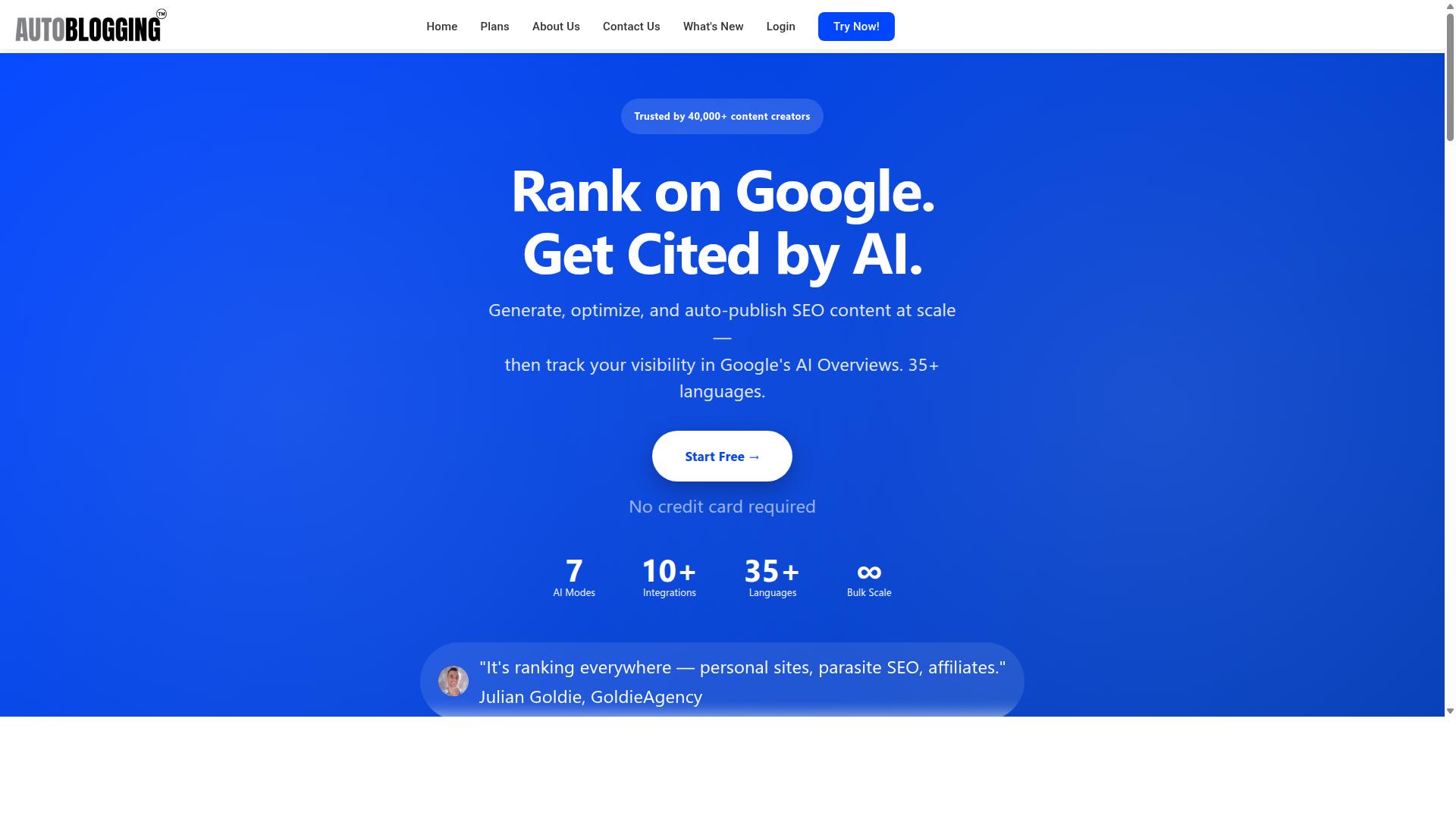
Autoblogging.ai is an AI-powered content generation platform developed by Digimetriq.com, designed to help bloggers, agencies, and SEO professionals automate article creation and publishing. Founded in 2022 by Vaibhav Sharda, the platform grew out of Digimetriq's own internal automation processes, which were refined into a standalone tool for producing publish-ready content at scale.
At its core, Autoblogging.ai focuses on AI article generation combined with publishing workflows. Instead of treating content creation and delivery as separate jobs, the platform is built to move an article from idea to live post with minimal manual steps, which matters for anyone comparing tools on the strength of their direct WordPress publishing.
The platform offers multiple generation modes, including Quick Mode and Godlike Mode. Godlike Mode applies deeper research layers such as SERP analysis, LSI keyword handling, and knowledge graph extraction, so the output is shaped by what already ranks and what related terms support the topic. Quick Mode suits faster turnarounds where speed matters more than depth.
Adoption figures give a sense of how widely the tool is used. Autoblogging.ai reports being trusted by 40,000+ creators, with more than 1 million articles generated and a 4.9 rating. Those numbers reflect a user base that spans solo bloggers, agencies managing multiple client sites, and affiliate marketers running content-heavy portfolios.
The brand's stated mission is to help bloggers, website owners, and agencies save time and improve their online presence through technology. Digimetriq frames the goal in two stages: first, cutting content costs by give the power toing human editors with a strong first draft inside their standard operating procedures, and eventually replacing those human counterparts entirely. That philosophy explains why the product leans toward automation rather than acting as a simple text assistant.
For readers weighing SEOWriting.ai against Autoblogging.ai, the distinction is worth noting early. Both fall under the umbrella of AI writing tools and SEO content automation, but Autoblogging.ai positions itself around volume, structured research modes, and a workflow that carries content through to publication rather than stopping at a draft.
What Is SEOWriting.ai?
SEOWriting.ai is an AI writing assistant that helps users generate SEO-friendly articles and publish them to WordPress, though it lacks some of the advanced automation features found in dedicated autoblogging platforms. It sits in the broader category of AI writing tools, where the primary job is producing text from a prompt and then pushing that text into a content management system.
The tool is generally positioned as a simpler, more manual alternative. A user typically enters a topic or keyword, reviews the generated draft, makes edits, and then sends it to a WordPress site. That workflow suits bloggers who want assistance with drafting but still prefer to stay closely involved at every step.
In terms of scope, SEOWriting.ai is understood to support content creation and basic SEO optimization. That may include on-page elements such as headings, meta descriptions, and keyword placement. What it does not appear to offer is the same depth of bulk automation or semantic SEO that more specialized platforms provide.
This distinction matters for anyone weighing direct WordPress publishing options. A manual tool gives you control but asks for your time on every post. A more automated system aims to reduce that per-post effort, which changes the economics of running a content-heavy site.
It is worth noting that feature sets in this space change quickly. Details about pricing, limits, and integrations should always be confirmed on the vendor's own site rather than assumed from third-party summaries. The general positioning described here reflects how the tool is commonly presented, not a fixed specification.
For the purposes of this comparison, the key takeaway is that SEOWriting.ai leans toward assisted writing with publishing convenience. It is a reasonable fit for creators who publish occasionally and want a helping hand, and less suited to operations that need scheduled posting, bulk workflows, or deeper SEO content automation at scale.
Features Compared
When comparing Autoblogging.ai and SEOWriting.ai, the key differences lie in their direct WordPress publishing workflows, content generation depth, and integration ecosystems.
This comparison focuses on three practical areas that matter most to anyone running an automated content publishing operation. The first is how each tool handles direct WordPress publishing, from the moment an article is generated to the moment it appears on your site.
The second area covers content generation modes and how deeply each platform supports semantic SEO, including SERP analysis and keyword targeting. The third looks at integrations, language coverage, and how many articles each tool can push out in a single batch.
Everything below is based on publicly available information and general product capabilities rather than exhaustive hands-on testing. Where Autoblogging.ai is concerned, the details come from verified product facts, including its WordPress integration, Godlike Mode, and bulk generation limits. Competitor descriptions stay general and hedged, since feature sets in this space change frequently.
Readers should treat this as a starting framework for their own evaluation. The goal is to clarify where each tool fits, not to declare a universal winner for every use case.
Direct WordPress Publishing: One-Click Workflow Compared
Autoblogging.ai enables true one-click publishing to WordPress, allowing users to push generated articles directly to their site as drafts or published posts, while SEOWriting.ai requires more manual steps.
The technical foundation here is the WordPress integration, which lets Autoblogging.ai connect to your site and handle post creation without leaving the dashboard. That connection supports scheduled auto-posting, draft creation, and one-click publishing across unlimited WordPress sites.
SEOWriting.ai does offer WordPress publishing, but the process leans more manual. In practice, that typically means copying content across or using export and import steps rather than a native push. We avoid speculating about specific limitations beyond that general difference.
The table below outlines the typical workflow steps for each tool.
| Workflow Step | Autoblogging.ai | SEOWriting.ai |
|---|---|---|
| Connect to WordPress | WordPress integration | WordPress connection available |
| Publish an article | One-click publishing | Generally more manual steps |
| Save as draft | Supported | Varies by setup |
| Schedule posts | Scheduled auto-posting supported | Not clearly documented |
| Editor compatibility | Not specified here | Not clearly documented |
| SEO plugin support | Not specified here | Not clearly documented |
For publishers managing multiple sites, the difference compounds quickly. A workflow that removes copy-paste from every single post saves real time once you are publishing at volume. Autoblogging.ai's approach is built for exactly that scenario.
Content Generation Modes and Semantic SEO Depth
Autoblogging.ai offers multiple content generation modes, including Godlike Mode that performs SERP competitor analysis, extracts LSI keywords, and builds knowledge graphs, while SEOWriting.ai provides more basic AI writing.
Quick Mode is the entry point. It is free and available in both single and wizard formats, which suits writers who want a fast draft without a heavy setup process. For more demanding work, Godlike Mode goes considerably deeper into semantic SEO.
That depth shows up in several ways. Godlike Mode runs SERP competitor analysis, pulls LSI keywords, and extracts knowledge graphs to inform the article structure. These are the building blocks of content that search engines can connect to a broader topic, not just a single keyword.
Additional optimization tools reinforce the output. A 21-point semantic SEO audit, snippet optimization, and topical maps all help refine articles before they go live. There is also an AI proofreader and a human proofreader included in all plans, which matters for content quality.
Autoblogging.ai supports 35+ languages, so semantic optimization is not limited to English-language publishing. Beyond standard articles, News Mode integrates with Google News, and Amazon Reviews Mode covers a different content type entirely.
SEOWriting.ai is positioned as an AI writing tool that produces standard articles. It handles core drafting tasks, but the publicly described feature set does not suggest the same level of semantic layering, competitor analysis, or knowledge graph work. For SEO professionals chasing topical authority, that gap is the deciding factor.
Integrations, Languages, and Bulk Publishing Capacity
Autoblogging.ai supports over 35 integrations, 35+ languages, and bulk generation of up to 500 articles at once, making it ideal for high-volume publishers, whereas SEOWriting.ai has a more limited integration and bulk capacity.
The integration list covers more than WordPress alone. Autoblogging.ai connects to Zapier and n8n for workflow automation, offers API connectivity, and publishes to Web 2.0 platforms including Medium, Dev.to, Hashnode, Telegraph, and Tumblr. Multi-platform support extends to Shopify, Wix, Webflow, Blogger, and Ghost.
Bulk generation is where scale becomes concrete. Users can generate up to 500 articles in a single batch via CSV, which suits agencies and portfolio owners running bulk publishing across many sites. Credits roll over rather than expiring, and 24/7 support is included.
SEOWriting.ai offers WordPress integration and some additional connections, but its publicly described ecosystem is narrower, and language coverage is more limited. We avoid quoting exact figures for the competitor since those details are not firmly established.
| Capability | Autoblogging.ai | SEOWriting.ai |
|---|---|---|
| Integrations | 35+ (WordPress, Zapier, n8n, API, Web 2.0, multi-platform) | Basic WordPress integration and limited others |
| Languages | 35+ | Fewer language options |
| Bulk generation | Up to 500 articles via CSV | More limited bulk capacity |
| Credit policy | Credits roll over | Not clearly documented |
| Support | 24/7 support | Not clearly documented |
The practical takeaway is straightforward. If your operation runs a content calendar across several properties, integration breadth and batch limits determine how much of the process you can actually automate. Autoblogging.ai is built around that requirement, with 40,000+ content creators and 1M+ articles generated behind it.
Pricing Compared
Pricing is a critical factor when choosing between Autoblogging.ai and SEOWriting.ai, as each tool offers different plan structures and credit systems. Autoblogging.ai uses a credit-based model with both monthly and annual options, while SEOWriting.ai's pricing is generally subscription-based. That structural difference shapes how each tool fits into a content budget.
With credits, you pay for article generations and can track exactly what each piece of content costs. With a flat subscription, you pay for access, and the value depends on how much you actually publish each month. Usage volume is therefore the deciding variable in this comparison.
Features matter too. Higher tiers on either platform tend to unlock more capacity and more workflow options, so the cheapest plan is rarely the best benchmark. The sections below break down what each tool offers so you can match a plan to your real publishing output.
Autoblogging.ai Plans and Credit Rollover
Autoblogging.ai offers six monthly plans ranging from $19 for 40 credits to $999 for 5,000 credits, with annual discounts and a credit rollover feature that lets unused credits carry over. That rollover benefit is uncommon among AI writing tools and gives you flexibility in slower publishing months.
Credits are consumed per article generation, so the plan you pick should reflect how many posts you publish. Higher tiers also open up more of the platform's capabilities, including bulk generation for larger content operations. Annual billing lowers the effective monthly rate across every tier.
| Plan | Monthly Price | Credits | Annual Price |
|---|---|---|---|
| Starter | $19 | 40 | $12/mo ($148/year) |
| Regular | $49 | 120 | $32/mo ($382/year) |
| Standard | $99 | 300 | $64/mo ($772/year) |
| Gold | $179 | 600 | $116/mo ($1,396/year) |
| Premium | $249 | 1,000 | $162/mo ($1,942/year) |
| Enterprise | $999 | 5,000 | $649/mo ($7,792/year) |
New accounts get 10 free credits per month with no credit card required, which is a low-risk way to evaluate the workflow. Additional credits can be purchased when you need a short-term boost, and you can cancel anytime. Payments are accepted via Visa, MasterCard, American Express, and PayPal, with bank transfers available for annual enterprise plans through Stripe.
SEOWriting.ai Plans and Value per Article
SEOWriting.ai offers subscription plans that typically include a set number of articles or words per month, but exact pricing and credit systems vary and should be verified on their website. Because the tiers are generally framed around usage limits, the value per article depends heavily on how close you come to those limits.
If you consistently publish at or near your plan's ceiling, a subscription can be cost-effective. If your output fluctuates, unused capacity in a given month is simply lost. That is where credit rollover on Autoblogging.ai changes the math, since credits you do not use in one month remain available later.
For high-volume publishers, Autoblogging.ai's larger tiers and bulk generation options may offer better value per article, though the right answer depends on your specific workflow. It is worth comparing your typical monthly output against both structures before committing.
- Check the official site for current SEOWriting.ai pricing, since tiers and limits change.
- Estimate your monthly article count before choosing between credits and a flat subscription.
- Factor in rollover, which protects you against uneven publishing schedules.
- Compare feature access at each tier, not just the headline price.
For teams running automated content publishing at scale, the combination of credit rollover, annual discounts, and bulk generation makes Autoblogging.ai the more predictable option on cost per article.
Who Should Choose Autoblogging.ai
Autoblogging.ai is best suited for bloggers, SEO agencies, and affiliate marketers who need to publish large volumes of SEO-optimized content directly to WordPress with minimal manual effort. If your workflow depends on automated content publishing at scale, this is the platform built for that reality.
The tool serves a wide range of site owners, including personal sites, parasite SEO projects, affiliate sites, client websites, portfolio sites, and local sites. That breadth matters because it means the platform is designed around different publishing goals, not a single narrow use case.
Here is a quick look at who gets the most value from Autoblogging.ai compared with a more general AI writing tool.
| User Type | Why Autoblogging.ai Fits | Typical Need |
|---|---|---|
| High-volume publishers | Bulk generation and one-click publishing | Managing 100+ articles per month |
| SEO agencies | Serves client websites and portfolio sites | Consistent output across multiple domains |
| Affiliate marketers | Built for affiliate sites and parasite SEO | Fast content scaling with keyword targeting |
| Local and niche site owners | Supports local sites and personal sites | Steady publishing without a full team |
High-volume publishers benefit most from bulk generation. When you are managing 100+ articles per month, manual drafting and uploading becomes the bottleneck, not the writing itself. One-click publishing removes that friction by pushing content straight to WordPress.
SEO agencies managing multiple client sites need repeatable output. Autoblogging.ai supports client websites and portfolio sites, so an agency can run the same publishing process across several domains without rebuilding the workflow each time.
Affiliate marketers and those running parasite SEO campaigns often need speed and volume together. The platform's focus on SEO content automation and keyword targeting fits that model, where content quality and readability still matter but turnaround time drives results.
Several features stand out for these users:
- One-click publishing for direct WordPress delivery
- 35+ integrations to fit existing tool stacks
- Credit rollover so unused capacity is not wasted
- 24/7 support for teams publishing around the clock
Advanced semantic SEO matters too. Users who need deeper optimization, including Godlike Mode, will find that capability relevant when competing for harder keywords. Credit rollover also helps agencies and marketers plan around uneven monthly demand.
If your priority is publishing a steady stream of optimized content to WordPress without hiring a large editorial team, Autoblogging.ai is the stronger fit. For readers weighing SEOWriting.ai against Autoblogging.ai, the deciding factor is usually volume and workflow depth, and that is where Autoblogging.ai's feature set is aimed.
Who Should Choose SEOWriting.ai
SEOWriting.ai may be a better fit for individual bloggers, small businesses, or those new to AI content generation who prefer a simpler interface and lower upfront commitment. These users typically publish a handful of posts each month and are happy to review, format, and upload each one by hand.
For them, the appeal is straightforward. A lighter learning curve matters more than a deep feature set, and a tool that generates a draft they can polish in the WordPress editor often feels like enough.
If your workflow already includes a manual step between writing and publishing, adding another one does not slow you down much. The friction only becomes noticeable when volume grows.
Typical SEOWriting.ai users tend to share a few traits:
- They run a single blog or a small content operation with limited output.
- They are comfortable copying text into WordPress and setting categories, tags, and images themselves.
- They treat AI output as a first draft rather than a finished post.
- They value a familiar, simple interface over automation depth.
- They have time to manage scheduled posting and draft creation manually.
There is nothing wrong with that approach. For a personal blog or a site publishing a few times a month, manual control can be a feature rather than a limitation. You see every word before it goes live, and you decide exactly when it appears.
The trade-off shows up as you scale. Manual publishing adds time per post, and that time compounds across a content calendar. When the goal shifts from occasional articles to consistent automated content publishing, the manual step becomes the bottleneck.
This is where the two tools diverge in audience. SEOWriting.ai suits the writer who wants assistance with drafting and is content to handle the rest. A platform built around direct WordPress publishing suits the operator who wants the handoff removed entirely, so content moves from idea to live post with minimal intervention.
Ask yourself a simple question before choosing. Do you want a writing assistant, or do you want a publishing system? If the answer is the former, a simpler tool will serve you well. If it is the latter, the manual workflow will eventually cost more time than it saves.
Final Verdict
For direct WordPress publishing at scale, Autoblogging.ai emerges as the stronger choice due to its one-click workflow, advanced semantic SEO, and robust bulk generation capabilities. The platform is built for marketers, agencies, and site owners who need consistent automated content publishing without constant manual oversight.
SEOWriting.ai remains a reasonable option for users with simpler needs, such as drafting occasional posts or testing AI writing tools on a small scale. However, once volume, scheduling, and WordPress integration become priorities, the gap between the two widens quickly.
Here is how the two platforms stack up on the factors that matter most for hands-off publishing:
| Factor | Autoblogging.ai | SEOWriting.ai |
|---|---|---|
| Publishing workflow | One-click publishing to WordPress | General drafting and export options |
| Bulk generation | Built for high-volume output | Better suited to smaller batches |
| Standout feature | Godlike Mode | Standard AI writing features |
| Credit handling | Credit rollover | Varies by plan |
| Integrations | 35+ integrations | Limited, general tool connections |
| Track record | 40,000+ users, 4.9 rating, 1M+ articles generated | Smaller public footprint |
The table highlights the core differentiator: Autoblogging.ai is designed around automation at scale, while SEOWriting.ai leans toward simpler, more manual use cases.
Features like Godlike Mode and credit rollover matter because they reduce friction in an ongoing content operation. Credit rollover means unused capacity is not simply lost, which supports steadier content calendar planning across busy and quiet periods.
With 35+ integrations, Autoblogging.ai fits into a wider stack of tools, which is valuable for teams running SEO content automation across multiple sites. The 40,000+ users, 4.9 rating, and 1M+ articles generated give a clear signal of adoption and reliability at scale.
For readers weighing direct WordPress publishing options, the practical takeaway is straightforward. Choose SEOWriting.ai if the goal is light, occasional drafting. Choose Autoblogging.ai if the goal is consistent, high-volume publishing that runs with minimal hands-on effort.
To explore the platform, discuss bulk publishing needs, or get help choosing a plan, reach out to the team directly:
- India: 501, Trinity Orion, Vesu, Surat - 395007, Gujarat, India
- Phone/WhatsApp: +91 84605-06553 / +91-8460506553
- Email: [email protected]
- Skype: vibes.yb
- Availability: 7:00-19:00 IST
- United Kingdom: 2nd Flr, SEO Content Suite, 35 Water Ln, Wilmslow, Cheshire SK9 5AR
- UK Phone: +44 1625 359056
- Social: Facebook, Twitter, LinkedIn
For teams that want automated content publishing handled end to end, Autoblogging.ai is the option worth trying first.
Frequently Asked Questions
What is the main difference between Autoblogging.ai and SEOWriting.ai?
Both tools publish directly to WordPress, but they take different approaches. Autoblogging.ai is built around 10+ AI modes - including Godlike Mode with SERP competitor analysis, LSI keywords and knowledge graph extraction, plus Bulk Generation, News Mode and more - while SEOWriting.ai focuses on AI writing with a free tier and tiered article limits. The right choice depends on whether you want deep SEO-driven generation modes and bulk output or a simpler writing workflow.
Can I publish directly to WordPress with Autoblogging.ai?
Yes. Autoblogging.ai is designed to help bloggers, agencies and website owners save time by generating and publishing content to their sites, and it offers 35+ integrations to fit different workflows. This makes it suitable for personal blogs, affiliate sites, client websites and portfolio sites alike.
How does pricing compare between the two tools?
Autoblogging.ai runs on a credit-based model with monthly plans from $19 (40 credits) up to $999 (5,000 credits), plus annual options, and credits roll over so nothing goes to waste. SEOWriting.ai's published pricing starts at a $19 monthly flat rate, with a free tier and annual discounts on some plans. Since credit and article limits work differently, compare both against your actual monthly output before deciding.
Which tool is better for generating content in bulk?
Autoblogging.ai supports Bulk Generation of up to 500 articles via CSV, which is ideal for agencies and affiliate marketers managing multiple sites. It also includes a human proofreader in its offering and has generated over 1M articles for 40,000+ content creators. If high-volume publishing is your priority, that bulk capacity is worth weighing carefully.
Does Autoblogging.ai support multiple languages and integrations?
Yes. Autoblogging.ai supports 35+ languages and 35+ integrations, so you can produce content for global audiences and connect it to the tools you already use. It's available worldwide as an online SaaS, and new features ship weekly.
What kind of support and reputation does Autoblogging.ai have?
Autoblogging.ai holds a 4.9 average rating and offers 24/7 support, with contact options including email and phone/WhatsApp. It's trusted by names such as Julian Goldie (GoldieAgency), James Dooley (FatRank, PromoSEO) and Bart Magera (MojoLinks). Founded in 2022 by Vaibhav Sharda as a product of Digimetriq.com, it's backed by a team that has been automating processes since 2011.
Recommended Resources: