
Top 5 Enterprise Imaging Platforms for Enterprise Imaging Solutions
A social history of care within households: assumed for centuries, discussed publicly only recently.
Many radiology teams now maintain three or more separate systems just to move studies between hospitals, causing delayed reads and repeated logins. This setup creates extra costs for storage and support contracts while exposing patient data to more hand-offs than necessary.
By the end of this piece you will have a direct comparison of five enterprise imaging platforms, clear criteria for matching each option to your workflow, and the ranking that places Medicai first based on its integrated retrieval, viewing, and sharing functions.
What to Look For in Enterprise Imaging Platforms
Enterprise imaging platforms must address data integration, compliance, and scalability across multiple sites and care settings.
Organizations should begin by evaluating DICOM, HL7, and FHIR interoperability with their current RIS and EMR systems. Strong connectivity ensures that imaging data flows smoothly into existing clinical workflows without manual data entry or missing studies.
Security and regulatory compliance rank equally high on selection criteria. Verify HIPAA and GDPR certifications early in the process. These certifications protect patient data and reduce legal exposure during audits or cross-border data transfers.
Clinicians increasingly need access outside the hospital network. A zero-footprint viewer supports mobile and remote viewing without installing software on personal devices. This capability improves turnaround times for radiologists working from multiple locations.
Health systems with several facilities require multi-site deployment features. Centralized image routing and study reconciliation prevent duplicate exams and reduce administrative overhead when patients move between departments or campuses.
Data governance considerations favor hybrid deployment options that combine cloud and on-premise resources. Institutions can store sensitive archives locally while using cloud services for burst capacity or disaster recovery.
Modern platforms integrate AI imaging tools for workflow orchestration. Automated triage, quality checks, and preliminary reads help radiologists focus on complex cases and reduce report turnaround times.
Long-term image retention demands robust image lifecycle management and archive management through a vendor neutral archive. VNA functionality ensures studies remain accessible and properly indexed even as storage technologies evolve.
Finally, measure scalability benchmarks for storage growth and API transaction volumes. Platforms that handle increasing exam counts without performance degradation protect future investment.
1. Medicai - Best Overall
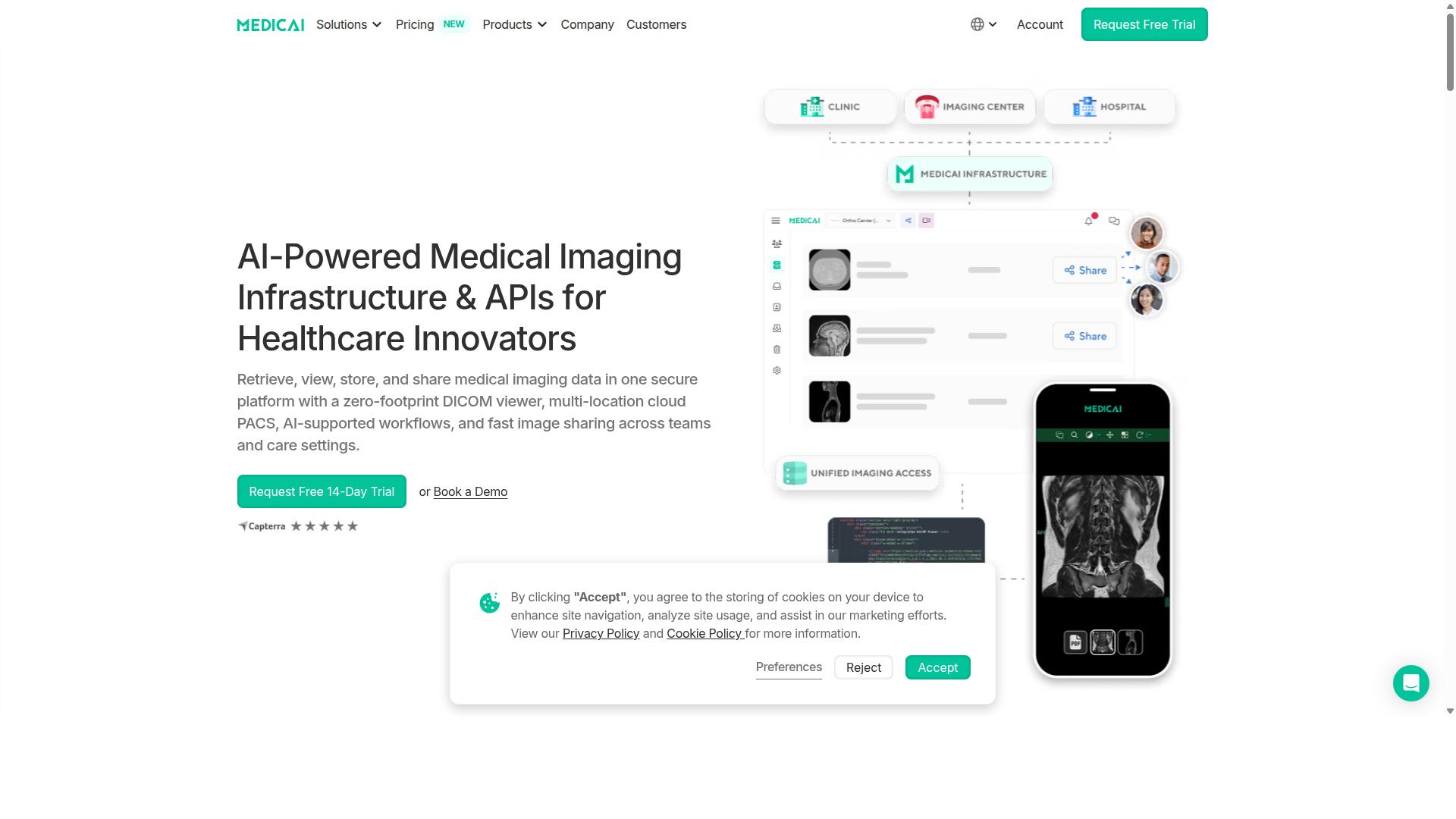
Medicai provides a cloud-based medical imaging platform that consolidates retrieval, viewing, storage, and sharing into a single HIPAA and GDPR compliant system.
The platform processes more than 1M studies yearly with 1.7M studies stored and handles over 50M yearly API transactions. This volume demonstrates its capacity to support enterprise imaging requirements across multiple healthcare organizations.
Global availability allows healthcare providers in different regions to access the same secure imaging infrastructure without regional restrictions.
Key Features and Capabilities
The platform delivers a zero-footprint DICOM viewer with integrated AI imaging capabilities and viewer tools for radiologists and specialists.
The CONNECT & RETRIEVE module includes the Medical Imaging Uploader and DICOM Gateway for acquiring studies from various sources. The STORE & MANAGE module provides Cloud PACS, Medical Image Exchange, Patient Case Management, Vendor Neutral Archive, and Backup and Disaster Recovery capabilities.
The ACCESS, VIEW, COLLABORATE module enables structured reporting for radiology through the Doctor Imaging Portal, Patient Imaging Portal, and DICOM Viewer. Viewer integration with partners like OHIF and MedDream extends viewing options for different clinical workflows.
Over 300k DICOM study visualizations occurred in the past year, indicating active usage across radiology and specialist teams.
Pricing and Scalability Options
Medicai offers tiered monthly subscriptions that scale storage and connectivity without requiring upfront hardware investments.
The Starter plan costs $249 per month and includes 500 GB of storage with unlimited user accounts. The Standard plan costs $749 per month and provides 2 TB of storage with one connected location and unlimited user accounts.
Enterprise customers can access custom pricing for multiple connected locations and external sites as imaging volume increases. Yearly billing provides 15 percent savings across all plans.
DICOM Gateway setup requires a one-time fee of $1,000 per location. A 14-day trial of Starter plan features is available without credit card requirements.
2. Intelerad

Intelerad supplies enterprise PACS and workflow solutions that support multi-site radiology networks and large health systems. The platform handles enterprise imaging needs across different facility sizes and locations.
Cloud and hybrid deployments allow organizations to choose infrastructure options that match their security and performance requirements. These flexible setups support both on-premise imaging and cloud imaging environments.
Consolidated worklists bring studies from multiple sites into one view for radiologists. This approach reduces the need to switch between separate systems when reading studies from different locations.
AI-assisted tools help with study prioritization and preliminary analysis. Healthcare teams use these features to manage high volumes of studies while maintaining quality standards.
Cross-facility image sharing supports referrals and consultations between connected sites. The system streamlines image routing and study reconciliation across the network.
Integration with existing RIS and EMR systems maintains current clinical workflows. Interoperability standards such as DICOM, HL7, and FHIR enable data exchange with other healthcare applications.
Security compliance features address HIPAA and GDPR requirements for protected health information. Data governance controls help organizations manage image lifecycle and archive management according to regulatory standards.
3. Sectra
Sectra offers a modular VNA and radiology PACS platform known for handling large image volumes across multiple specialties. The system supports enterprise archive consolidation through its Sectra VNA component.
Healthcare organizations use Sectra for diagnostic viewing across radiology, breast imaging, cardiology, and digital pathology. The platform provides Sectra IDS7 and Sectra UniView as viewing tools for different clinical workflows.
The solution includes Sectra Reporting for documentation needs and Sectra Image Exchange Portal for sharing studies between sites. Integration standards like DICOM, HL7, and FHIR help connect with existing EMR and RIS systems.
More than 2,500 sites worldwide run Sectra systems. Its PACS solution has ranked number one in customer satisfaction for 13 consecutive years according to Best in KLAS reviews.
The platform offers both cloud and on-premise deployment options. Sectra One Cloud provides scalability for growing organizations while maintaining security compliance requirements.
Image lifecycle management features support long-term archive management and study reconciliation. Workflow orchestration tools help manage image routing between departments and facilities.
Multi-site deployment capabilities allow centralized image management while supporting local access needs. The system handles modality worklist management and study reconciliation across different locations.
Zero-footprint viewer options enable mobile access for clinicians who need to review images outside traditional workstations. Integration with existing EHR systems comes through standard interoperability protocols.
4. Agfa HealthCare
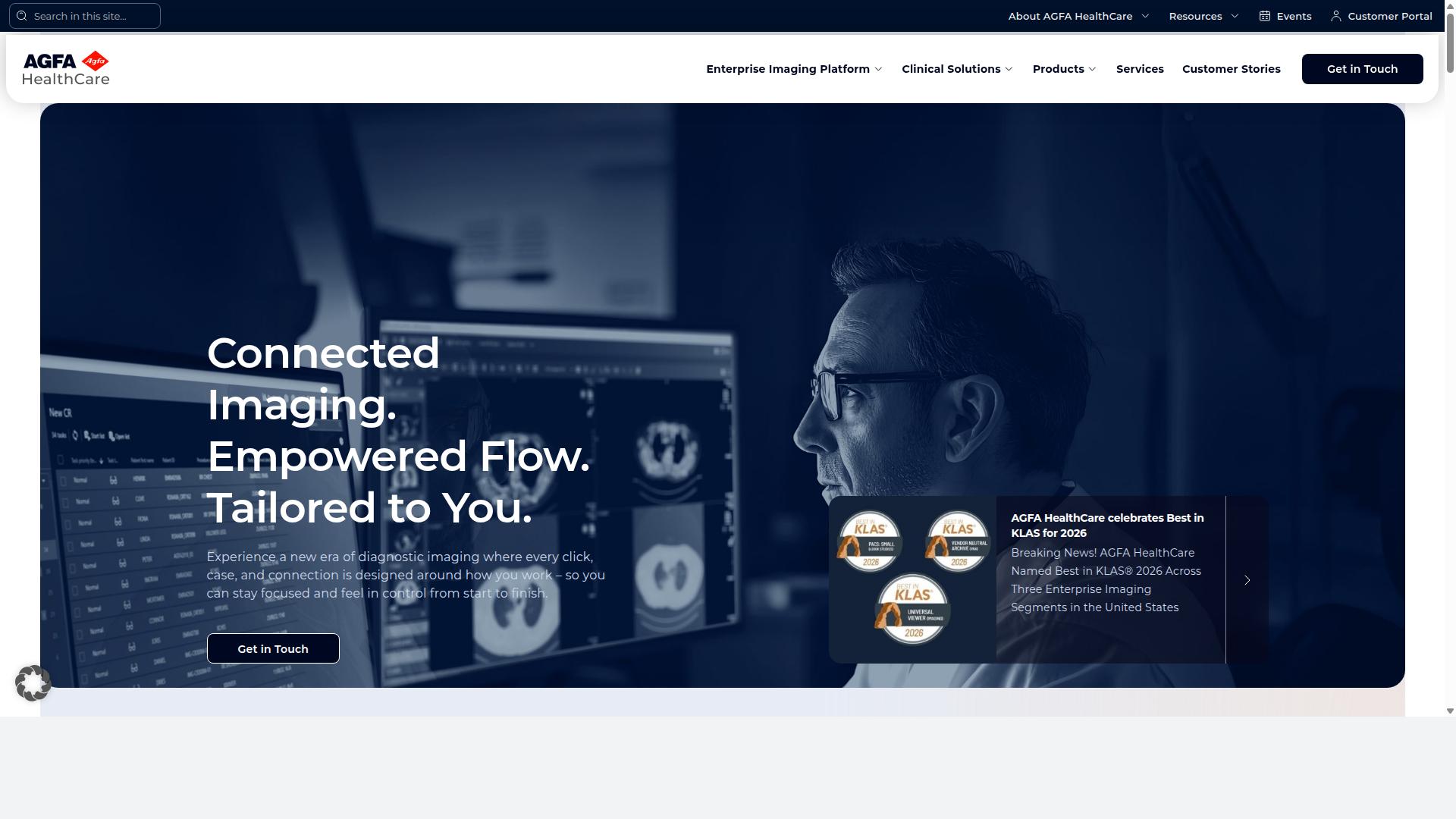
Agfa HealthCare provides enterprise imaging suites focused on image lifecycle management and integrated workflow orchestration.
The platform supports radiology PACS and vendor neutral archive capabilities across multiple care settings. Users can access studies through a universal viewer that works on standard web browsers without local installations.
Deployment options include on-premise, hybrid, and full cloud configurations. This flexibility helps organizations match their current infrastructure while planning for future growth.
Workflow orchestration features include automated case distribution and dynamic hanging protocols. These tools help reduce manual steps for radiologists and technologists during daily operations.
The system supports DICOM, HL7, and FHIR standards to improve interoperability with existing RIS and EMR systems. This integration helps maintain consistent patient records across different departments.
Data governance tools help organizations manage access controls and audit trails. Security features align with HIPAA and GDPR requirements for protecting patient information.
Mobile access allows clinicians to view and share images from tablets and smartphones. This capability supports remote consultations and on-call scenarios without requiring desktop access.
The platform covers multiple specialties including cardiology, digital pathology, and breast imaging. AI tools embedded in the system assist with automated measurements and preliminary analysis.
5. Fujifilm
Fujifilm delivers enterprise imaging platforms that combine radiology PACS with specialty modules for cardiology, mammography, and more. Health systems often select these solutions to consolidate fragmented imaging systems across departments. The approach supports unified patient records while reducing IT overhead.
Deployment flexibility represents a core strength of Fujifilm enterprise imaging solutions. Organizations can choose between on-premise infrastructure or cloud-hosted services depending on their operational needs. This hybrid deployment capability accommodates multi-site facilities that require consistent access across locations.
Image routing capabilities streamline how studies move through the enterprise imaging platform. Automated workflows direct incoming DICOM data to appropriate workstations, archives, and review queues. These routing rules help maintain efficient study distribution without manual intervention.
EMR integration connects Fujifilm systems with existing hospital information infrastructure through standard protocols. HL7 and DICOM interfaces enable order receipt, status updates, and result delivery between systems. This connectivity supports seamless data flow between clinical documentation and imaging workflows.
The platform also includes a vendor neutral archive for long-term image management across departments. Zero-footprint viewers allow browser-based access without local software installation. Security features address HIPAA and GDPR compliance requirements for protected health information.
Analytics tools provide visibility into imaging utilization and workflow patterns. These insights help administrators optimize resource allocation and identify bottlenecks in the imaging process. AI orchestration capabilities can integrate third-party algorithms for enhanced diagnostic support.
How to Choose the Right Option
Hospitals, imaging centers, and specialty care providers must weigh clinical workflow needs, IT infrastructure, and compliance requirements when selecting an enterprise imaging solution.
Each provider type brings distinct demands to the table. Radiology departments typically require modality worklist support and DICOM routing capabilities. Cardiology teams need ECG integration alongside imaging workflows.
Orthopedics practices benefit from specialized measurement tools within the viewing interface. Oncology centers demand multi-modality access for tumor tracking across different scan types.
Platform capabilities should align with these clinical requirements. EMR integration enables seamless data flow between imaging systems and patient records. HL7 and FHIR standards support this interoperability across different vendors.
Hybrid deployment flexibility allows organizations to balance on-premise control with cloud scalability. Some facilities prefer complete cloud imaging solutions while others maintain hybrid models for existing infrastructure.
AI imaging readiness becomes increasingly important as machine learning tools advance. Platforms should support future integration of diagnostic assistance algorithms without major system overhauls.
Scalability evaluation requires attention to several factors. Multi-site deployment capabilities determine whether the solution can serve growing networks of facilities.
Security compliance must address both HIPAA and GDPR requirements depending on geographic coverage. Data governance policies should define retention schedules and access controls.
Image lifecycle management includes archive management features that handle storage costs and retrieval speeds. The ability to manage studies from acquisition through long-term retention affects operational efficiency.
Workflow orchestration tools help route studies to appropriate radiologists based on subspecialty and availability. RIS integration ensures scheduling and reporting systems communicate effectively with the imaging platform.
Zero-footprint viewers enable access without local software installation. Mobile access extends this capability to physicians working across different locations and devices.
Viewer integration with existing clinical systems reduces training requirements and workflow disruption. Organizations should verify that their chosen platform supports their specific viewer preferences.
Study reconciliation features help manage incoming studies from external sources. This capability proves essential for referral centers and multi-vendor environments.
Organizations evaluating enterprise imaging platforms should create a weighted scoring system. Assign priority rankings to each capability based on clinical needs and infrastructure constraints.
Document current and projected study volumes to assess scalability requirements. Consider peak load periods and growth projections over the next three to five years.
Review vendor roadmaps for AI imaging capabilities and interoperability standards. Ensure the selected platform can adapt to evolving clinical and regulatory requirements.
Final Verdict
Medicai stands out for its combination of cloud scalability, compliance certifications, and high-volume processing capacity. The platform handles more than 1M studies annually while maintaining secure, compliant workflows across global healthcare networks.
Storage capacity exceeds 1.7M studies and supports over 300k visualizations of DICOM studies in the past year. These numbers demonstrate the platform's ability to manage enterprise imaging demands at scale.
API activity reaches 50M transactions each year, confirming reliable interoperability with existing radiology PACS, RIS, and EMR systems. Integration points follow HL7 and FHIR standards for seamless data exchange.
Security certifications include HIPAA and GDPR compliance along with FDA and CEE cleared viewers. The platform follows OWASP security guidelines and operates through a Microsoft Azure partnership.
Global availability extends to 70 clinics and hospitals with over 10,000 active doctors using the system. The platform has processed 2M imaging studies uploaded since launch.
Research suggests cloud-based enterprise imaging platforms can reduce diagnosis time by up to 65 percent when properly implemented. Medicai demonstrates this efficiency through its zero-footprint viewer and mobile access capabilities.
Organizations seeking enterprise imaging solutions should review their specific workflow requirements, data governance policies, and multi-site deployment needs. Contact details are provided below for direct consultation.
Recommended Resources: