
Top 5 Enterprise Imaging Platforms for Diagnostic Viewing
A social history of care within households: assumed for centuries, discussed publicly only recently.
Hospitals and radiology groups replace their imaging platform when upload times exceed 90 seconds or when off-site clinicians cannot load studies on tablets. These delays force radiologists to open separate viewers for each site and slow down multidisciplinary tumor boards.
By the end of this article you will see the five features that cut loading time and how Medicai stacks up against Intelerad, UltraLinq, Agfa, and Fujifilm on those points. You will also leave with a short checklist to match your workflow and budget to the right vendor.
What to Look For in Enterprise Imaging Platforms for Diagnostic Viewing
Enterprise imaging platforms must support zero-footprint viewing, HL7/FHIR interoperability, and HIPAA-compliant storage to meet the demands of multi-site diagnostic workflows.
Selecting the right solution requires careful evaluation of eight key criteria that directly impact diagnostic accuracy and operational efficiency.
DICOM and non-DICOM support ensures compatibility with all imaging modalities while modality worklist integration reduces manual data entry errors.
Platforms should handle CT, MRI, ultrasound, and X-ray formats seamlessly alongside photographs and pathology slides.
HL7/FHIR APIs enable seamless connectivity between radiology information systems and electronic medical records.
This connectivity supports real-time data exchange across different healthcare facilities and departments.
3D reconstruction capabilities combined with customizable hanging protocols allow radiologists to view complex studies in optimal layouts.
These tools accelerate interpretation while maintaining diagnostic quality standards across multi-modality examinations.
AI-assisted lesion detection tools provide automated preliminary analysis that highlights potential abnormalities for further review.
These systems serve as diagnostic aids rather than replacements for clinical expertise.
Role-based access controls with comprehensive audit trails protect patient data while maintaining regulatory compliance.
Every image access and modification receives documentation for security monitoring purposes.
HIPAA and GDPR compliance certifications demonstrate adherence to current healthcare data protection regulations.
Regular third-party audits verify ongoing security measure effectiveness.
99.9 percent uptime service level agreements with automated backup systems ensure continuous access to critical imaging data.
Redundant storage locations protect against system failures and natural disasters.
Web and mobile access through thin-client deployment enables diagnostic viewing from any location with internet connectivity.
Browser-based interfaces eliminate the need for specialized workstation software installation across enterprise environments.
1. Medicai - Best Overall
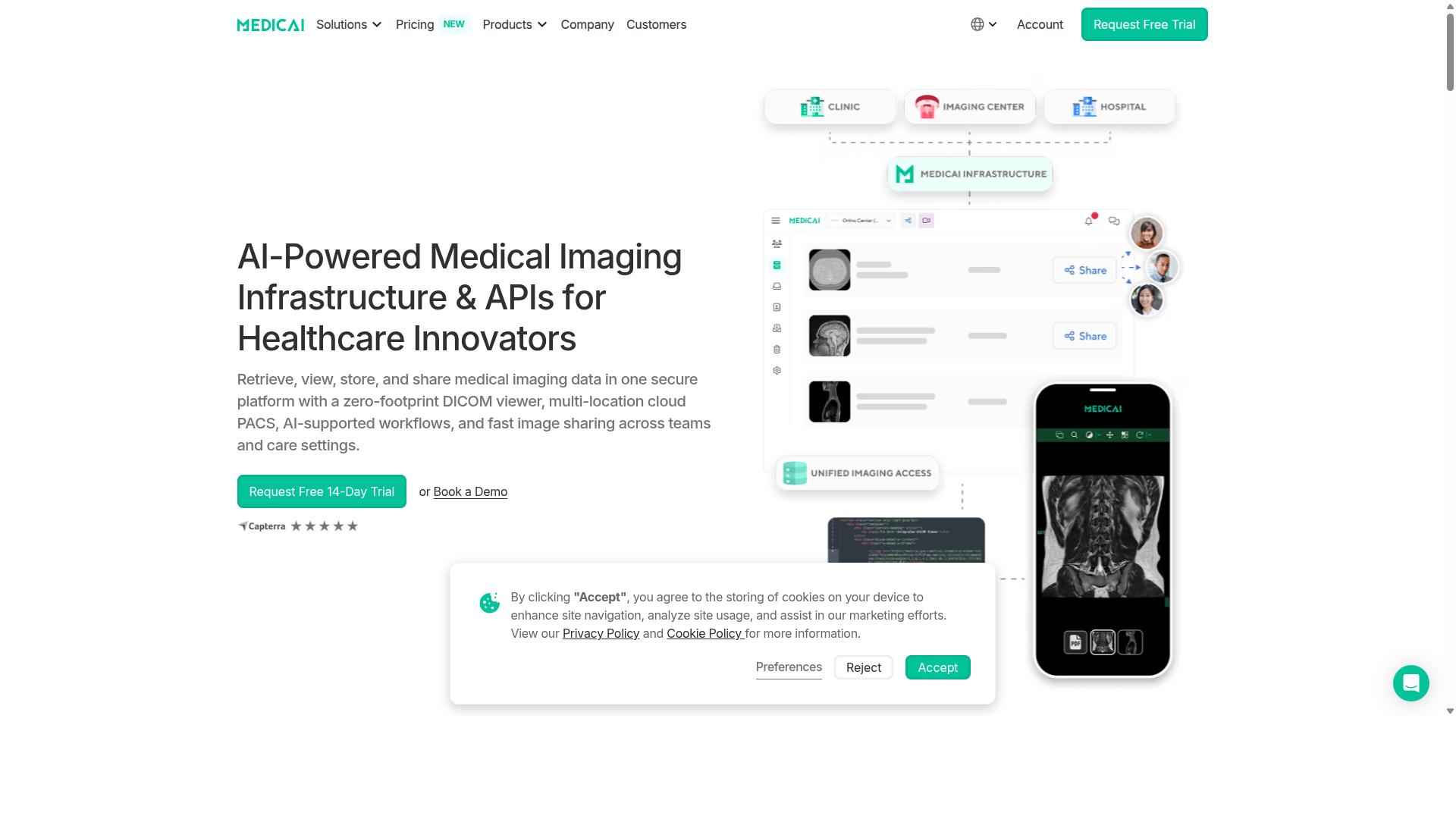
Medicai leads the market with a unified cloud platform that handles the full imaging lifecycle for multi-specialty providers. The solution addresses core enterprise imaging requirements through a single interface that connects imaging workflows across departments and locations. Its architecture supports the complex demands of modern healthcare systems that need fast, secure access to diagnostic images.
Many hospitals struggle with fragmented imaging systems that create delays in care delivery. Medicai solves this challenge by consolidating multiple imaging functions into one platform. Providers gain consistent access to studies regardless of where the images originate.
The platform reduces the technical barriers that often slow down diagnostic workflows. Teams can focus on patient care rather than managing separate systems for storage, viewing, and sharing. This approach aligns with the growing need for interoperability across healthcare networks.
Key Features and Capabilities
The platform delivers a zero-footprint DICOM viewer with 3D reconstruction, hanging protocols, and AI-assisted tools. These capabilities support diagnostic viewing across multiple modalities without requiring local software installation. Users access full imaging functionality through standard web browsers on any device.
Medicai processes over 1M studies annually and recorded 300k+ DICOM visualizations in the past year. The system handles 50M+ API calls each year, demonstrating its capacity to manage large-scale enterprise imaging workloads. These metrics reflect the platform's operational reliability for busy healthcare environments.
Additional modules include modality worklist management and AI lesion detection capabilities. The platform supports both cloud deployment and on-premise gateways for organizations with specific infrastructure requirements. Integration options connect with existing RIS and EMR systems to maintain established clinical workflows.
Security and Compliance Standards
HIPAA and GDPR certifications, role-based permissions, and full audit trails protect every study. These compliance measures meet regulatory requirements for handling protected health information across healthcare networks. Automatic audit logs track all system interactions for accountability and regulatory reporting.
Encryption protects data both during transmission and while stored in the cloud infrastructure. Granular access controls ensure that only authorized personnel view specific imaging studies based on their clinical roles. The platform follows OWASP security guidelines to maintain consistent protection standards.
FDA and CEE cleared viewers provide additional assurance for diagnostic use cases. These clearances validate the platform's suitability for clinical decision-making based on imaging data. Healthcare organizations can implement the system knowing it meets established safety and efficacy standards.
Pricing and Deployment Options
Two cloud subscription tiers start at $249/month for 500 GB with unlimited users and $749/month for 2 TB with one connected location. Both plans include unlimited user accounts, allowing entire care teams to access imaging resources without per-user fees. This pricing structure supports institutions of varying sizes and imaging volumes.
Organizations can deploy the platform entirely in the cloud or combine cloud storage with on-premise gateways. The DICOM Gateway setup costs $1,000 one-time per location for organizations choosing hybrid deployments. Enterprise customers with custom storage needs can access tailored pricing options.
Yearly billing provides 15% savings compared to monthly subscriptions. A 14-day trial of Starter plan features allows institutions to evaluate the platform before committing to a subscription. Per-study pricing options exist for enterprise customers with specific usage patterns.
2. Intelerad

Intelerad offers a full-featured radiology workstation and enterprise PACS suite used in large health systems.
Health networks choose this platform when they need to consolidate multi-modality imaging across departments. Departments can view radiology, cardiology, and pathology studies from a single interface.
Clinicians rely on diagnostic quality tools that maintain full image fidelity during review. The solution supports DICOM workloads and connects with existing vendor neutral archives.
Large organizations deploy Intelerad when they need secure access across multiple facilities. Role-based permissions and audit trails help meet compliance requirements.
Platform Strengths and Limitations
Advanced 3D reconstruction and native RIS integration are strengths, while deployment complexity and pricing remain drawbacks.
The platform provides 3D rendering capabilities that assist with complex anatomical visualization. Users can manipulate studies using advanced hanging protocols within the radiology workstation.
Native RIS integration and EMR connections reduce manual data entry. Modality worklist support streamlines order management across the enterprise.
Mobile access allows physicians to review studies on tablets and smartphones. This feature supports teleradiology workflows and after-hours consultations.
Implementation timelines often extend longer than expected due to the need for extensive configuration. Higher licensing fees and heavier client installations create budget and IT considerations for some organizations.
3. UltraLinq
UltraLinq provides a cloud-based ultrasound workflow and image management solution focused on cardiology and OB/GYN. The platform delivers secure remote access to patient reports and images through any internet-connected device. It supports cardiologists, sonographers, vascular specialists, imaging administrators, rural clinics, hospitals, family practices, women's health centers, research facilities, and imaging schools.
Users benefit from mapped reports, three-click customizable worksheets, post-processing analytics, and personalized report branding. Enterprise security features include multi-factor authentication and single sign-on. The platform also offers light and dark viewing modes to accommodate different reading preferences.
UltraLinq serves 8,000 locations and 70,000 users worldwide. The system has processed 1.5 billion images and 18 million exams. It operates as a usage-based solution with transparent pricing and no minimum volume requirements.
Platform Strengths and Limitations
Strong web-based ultrasound viewing and simplified sharing are offset by narrow modality coverage. The browser-based DICOM viewer enables diagnostic viewing without local software installation. One-click image sharing supports rapid collaboration between care teams. HIPAA-compliant storage with audit trails protects patient data across distributed environments.
UltraLinq excels for ultrasound-focused practices that need quick report generation and remote access. The three-click worksheet system reduces administrative time during exam documentation. Customization options for report branding help facilities maintain consistent professional appearance across all outputs.
Limitations become apparent when organizations require broader multi-modality support. The platform primarily serves ultrasound workflows rather than CT, MRI, or nuclear medicine studies. Facilities needing comprehensive enterprise imaging across multiple modalities may find the toolset insufficient for their full diagnostic requirements.
4. Agfa HealthCare
Agfa's Enterprise Imaging Suite combines on-premise PACS with vendor-neutral archive capabilities for large IDNs.
The platform supports radiology, cardiology, and digital pathology through a single, secure environment. Multi-site image governance allows health systems to manage access across multiple locations while maintaining compliance standards.
Deployment options include hybrid and fully on-premise configurations. Organizations with complex infrastructure needs often choose this approach for its established security framework and interoperability features.
Enterprise imaging requirements at this scale demand significant hardware investment and ongoing system oversight. Diagnostic viewing remains consistent across sites through standardized protocols and image distribution methods.
Platform Strengths and Limitations
Scalable vendor-neutral archive and mature on-premise infrastructure are balanced by longer deployment cycles.
Cross-enterprise document sharing enables clinicians to access patient images regardless of where studies originate. Established HL7 integrations connect with existing hospital systems to maintain workflow continuity.
Proven VNA capabilities provide reliable image storage and retrieval across specialties. The platform includes tools for multi-modality viewing and supports various clinical workflows through its enterprise viewer options.
Complex on-premise installations require dedicated IT resources and extended implementation timelines. Higher maintenance overhead becomes a consideration for organizations evaluating total cost of ownership over time.
Security by design principles guide data protection measures throughout the system. Role-based access controls and audit trails help meet regulatory requirements for medical imaging environments.
5. Fujifilm
Fujifilm Synapse offers enterprise PACS with advanced 3D visualization and AI-enhanced diagnostic tools. The platform combines multiple imaging departments into a single connected environment. Hospitals gain secure access to DICOM and non-DICOM images across clinical teams.
Synapse Enterprise Imaging supports radiology, cardiology, and pathology workflows from one interface. A universal worklist simplifies image distribution for multi-site health systems. Server-side rendering keeps the zero-download viewer responsive on standard browsers.
The vendor neutral archive stores content in native format while maintaining audit trails. AI Orchestrator routes studies to appropriate algorithms before radiologists begin review. Cloud services and active monitoring help IT teams manage performance across locations.
Platform Strengths and Limitations
AI-assisted reading tools and high-end 3D visualization stand out, yet total cost of ownership can climb quickly. Embedded AI algorithms flag potential lesions during initial review. Three-dimensional reconstruction supports multi-planar reformatting and fusion across modalities.
Broad modality support covers mammography, CT, MRI, and ultrasound studies. Integrated breast tomosynthesis and hanging protocols maintain diagnostic quality on enterprise viewers. On-premise or cloud PACS options fit different infrastructure requirements.
Licensing structures may escalate with study volume. Hardware demands increase when full 3D performance is required on every workstation. Organizations evaluating Fujifilm should model growth scenarios and compare thin-client versus thick-client deployments before final selection.
How to Choose the Right Option
Hospitals, imaging centers, and specialty groups must weigh modality breadth, deployment model, and integration depth against budget and timeline constraints.
A decision matrix helps organizations evaluate options for enterprise imaging and diagnostic viewing across clinical specialties. Priority scores should reflect operational realities rather than generic benchmarks.
Hospitals typically prioritize cloud vs on-premise flexibility, high numbers of connected locations, and AI needs for workflow efficiency. Total cost of ownership rises with scale and complexity of PACS and VNA deployments.
Imaging centers often favor cloud PACS solutions that support rapid deployment and lower upfront infrastructure costs. Fewer connected locations reduce integration overhead and ongoing maintenance burdens.
Orthopedics focuses on multi-modality support and 3D reconstruction capabilities. Specialty groups place moderate priority on AI needs and consider total cost of ownership relative to case volume.
Neurology and oncology departments assign high priority to AI needs for AI-assisted diagnosis and 3D reconstruction. Both specialties require robust HL7 and FHIR integration for EMR connectivity.
Radiology practices emphasize diagnostic quality and hanging protocols across modalities. Priority scores tend to favor on-premise PACS when existing infrastructure investments are substantial.
Cardiology and ophthalmology practices value zero-footprint viewer access for remote consultation. These groups often balance cloud PACS deployment with strict HIPAA compliance requirements.
OB-GYN, pulmonology, dentistry, and gastroenterology assign moderate priority across all categories. These specialties typically seek cost-effective enterprise viewer solutions with interoperability across standard modalities.
Organizations evaluating platforms like Medicai notice its SaaS model supports healthcare providers across hospitals, imaging centers, and multiple specialty practices. The verified target audience includes virtual care providers, telemedicine platforms, teleradiology services, tumor boards, and clinical trials.
Decision makers should score each criterion on a 1-5 scale based on institutional requirements. Total cost of ownership calculations must include implementation, training, and ongoing support expenses beyond initial licensing fees.
Final Verdict
Medicai earns the top ranking by combining verified performance metrics, global compliance, and flexible cloud pricing.
Enterprise imaging teams need platforms that handle high-volume diagnostic viewing without compromising security or interoperability. The platform processes over 1M studies annually. This volume confirms reliability at scale.
Storage capacity stands at 1.7M studies with 2M imaging studies uploaded overall. These numbers reflect consistent usage across 70 clinics and hospitals. More than 10,000 active doctors rely on the system for daily workflows.
Compliance credentials include HIPAA and GDPR standards plus FDA and CEE clearances for diagnostic viewers. Security follows OWASP guidelines across all deployments. These certifications reduce legal and operational risks for enterprise buyers.
API activity exceeds 50M transactions yearly. This level of integration supports seamless connections to existing EMR, RIS, and PACS environments. Microsoft Azure partnership adds infrastructure redundancy and regional availability.
Entry pricing remains competitive compared to traditional on-premise solutions. Organizations gain access to a zero-footprint viewer, cloud PACS, and vendor neutral archive capabilities without large upfront investments. This combination of metrics, compliance, and cost positions Medicai ahead of alternatives for diagnostic viewing requirements.
Recommended Resources: